




- THE ECB BLOG
How banks are adjusting to declining reserves
2 April 2026
As the Eurosystem normalises its balance sheet, central bank reserves – banks’ most liquid asset – keep declining. This post examines how banks adapt to lower levels of reserves and explains why take-up in the Eurosystem’s standard refinancing operations (SROs) is expected to increase.[1]
Central bank reserves have almost halved from a peak of €4.9 trillion in 2022 to €2.6 trillion in early 2026 (Chart 1a). While still abundant, they are unevenly spread across banks. This implies that, as the Eurosystem continues to shrink its balance sheet, some banks may need to source reserves sooner than others. At the same time, money market rates at which banks lend and borrow have moved closer to the deposit facility rate (DFR) – the main policy rate through which the ECB steers its monetary policy stance. In fact, secured money market – repo – rates last traded this close to the DFR in 2020. This blog post examines the implications of these trends.
In an annual Eurosystem survey, bank treasurers were asked about the preferred level of reserves they wish to hold. When compared to actual reserve holdings, we find that banks representing 26% of all euro area banking assets now operate close to what was indicated as their preferred level of reserves, up from 15% a year earlier (Chart 1b).[2] The group includes large banks, such as globally systemically important banks (G-SIBs), as well as custodians and asset managers – institutions that generally manage their liquidity more actively.
Looking ahead, reserves are projected to decline by about €470 billion per year, though this projection is subject to high uncertainty (Chart 1a).[3] While at present most banks are still holding abundant reserves, the share of banks nearing their preferred reserve levels is expected to increase. By the end of 2026, banks accounting for 50% of total banking assets are projected to reach their preferred level (Chart 1b). In other words, banks will have to more actively manage their liquidity.
Chart 1
Reserve positions of euro area banks
a) Projected path of reserves | b) Share of banks close to their preferred reserve level |
|---|---|
(EUR billions) | (percentage of banking assets) |
 |  |
Sources: ECB (Eurosystem market operations data and the Eurosystem Bank Treasurer Survey for the fourth quarter of 2025).
Notes: The left panel shows the projected path of euro reserves assuming take-up in standard refinancing operations is in line with the median SMA respondent. The uncertainty area around the projections is based on a range of alternative assumptions. The right panel classifies banks by the relative distance between their reserves in fourth quarter of the relevant year and their preferred reserve level indicated in Bank Treasurer Survey. Banks are classified as close to their preferred level if their reserve holdings are within a distance equivalent to 1% of total assets of the reserve target they indicated in the Eurosystem Bank Treasurer Survey. All other banks are classified as banks with abundant reserves. The projection for the fourth quarter of 2026 assumes that the aggregate decline in reserves will continue at the same pace as that observed for each bank business model group between the fourth quarter of 2024 and the fourth quarter of 2025.
As reserves decline, banks will increasingly rely on money markets and the Eurosystem refinancing operations to manage their reserve levels. Those banks that are closer to their preferred reserve levels or their internal regulatory targets will normally be the first to seek liquidity. We are analysing banks’ behaviour in money markets and central bank operations in order to learn how reserves are distributed through the market. We are also investigating how money market rates are evolving and how banks are adapting to the changes to the operational framework for implementing monetary policy announced in March 2024.
Liquidity is being redistributed smoothly
Commercial banks are actively lending and borrowing in money markets, which is redistributing their central bank reserves smoothly across banks and euro area countries. Currently this redistribution is working well – there are no signs of fragmentation. The repo market – the main money market to borrow and lend reserves – is dominated by banks with abundant reserves.[4] These are mainly dealer banks that intermediate liquidity. However, other banks are also becoming increasingly active in the repo market in order to manage their reserve levels (Chart 2). In fact, those closest to their preferred reserve levels borrow the most in the short-term repo market relative to their reserves.
Chart 2
Outstanding gross and net repo borrowing of banks

Sources: ECB (Securities Financing Transactions Data and the Eurosystem Bank Treasurer Survey) and ECB calculations.
Notes: The chart shows the average gross and net outstanding repo positions in 2025 by bank liquidity group. “Term repo” is defined as transactions by euro area banks against any collateral type with a maturity above one month. The bank liquidity groups are banks with reserves close to target (i.e. close to their preferred level); and banks with abundant reserves. For banks with abundant reserves we distinguish between those that are close to either their internal liquidity coverage ratio (LCR) or net stable funding ratio (NSFR) targets. Banks are considered to have optimised their LCR or NSFR if they are within 11 percentage points of their internal LCR target or 5.3 percentage points of their internal NSFR target. These ranges represent the 25th percentile of LCR standard deviations and the 50th percentile of NSFR standard deviations.
Banks are also active in term money markets – a market where they borrow and lend for longer than 30 calendar days. They use this market to manage their compliance with Basel III regulatory standards: the liquidity coverage ratio (LCR) and net stable funding ratio (NSFR). Survey evidence indicates that banks set internal targets above the 100% regulatory minimum for these regulatory ratios and are keen to defend them. When facing liquidity shortfalls, term money markets are typically the first point of access. This market activity has further redistributed reserves across euro area banks and countries, but it has also pushed up premia on term liquidity, as banks close to their regulatory targets increasingly borrow in these markets to fine-tune these ratios. In turn, activity and interest rates in the term segment can act as an early indicator of changing system-wide liquidity needs and as a benchmark for how attractive Eurosystem standard refinancing operations are. Figure 1 illustrates these interactions.
Figure 1
Illustration of the interaction of reserves with regulatory ratios, markets and the central bank

Source: ECB.
Short-term interest rates are close to the deposit facility rate
Overall, short-term market interest rates remain near the ECB’s DFR (Chart 3a). The benchmark rate for unsecured bank borrowing is the euro short-term rate (€STR). Its spread versus the DFR has gradually narrowed. Likewise, secured money market (repo) rates have moved closer to the DFR as collateral has become more abundant and reserves have continued to decline.
Chart 3
Short-term interest rates steered by the deposit facility rate
a) Spread between short-term rates and the DFR | b) Spread between repo rates and the DFR by borrower type |
|---|---|
 |  |
Sources: ECB data (Money Market Statistical Reporting and the Securities Financing Transactions Data) and ECB calculations.
Notes: The left panel shows the spread between the €STR and the DFR as well as the spread between the repo rate and the DFR, 5-day moving average excluding month-ends, where the repo rate is the weighted-average repo rate for one-day trades collateralised by euro area government bonds or other EU bonds. The repo rate is trimmed at the 25th and 75th percentiles. The right panel shows the transaction volume-weighted average repo rate for: borrowing banks that are close to their preferred reserve level; borrowing banks that have abundant reserves (see Chart 1b); and borrowing by hedge funds. The latest observation is for 30 March 2026.
The share of overnight repo trades above the DFR has increased to 40%, but this does not reflect funding pressures for banks. In fact, banks – including those with less abundant reserves – are still borrowing at rates just below the DFR on average (Chart 3b). Instead, repo rates above the DFR mainly reflect cash demand from hedge funds which are willing to pay the spread to fund their investment strategies in other market segments.
Lessons learned from other jurisdictions, i.e. the United States and the United Kingdom, underscore two points. First, money market rates can also be driven by other factors, such as higher collateral supply or higher non-bank demand for cash. And, second, it is not only banks’ reserve needs which can substantially influence money market rates.[5] So rising rates do not necessarily signal increasing scarcity of reserves, but may instead reflect shifts in market structure or funding conditions. In such cases, movements in certain segments of the money markets need to be interpreted with caution, as they may not provide a reliable signal about the overall liquidity environment.
Declining reserves to eventually lift take-up in ECB operations
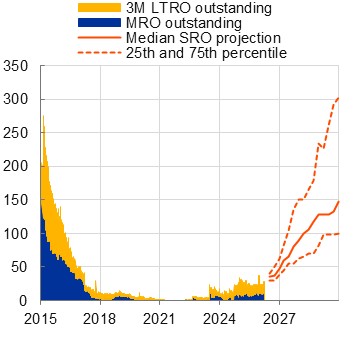
The demand for Eurosystem SROs remains low so far, because conditions in money markets continue to be favourable. On average, money market rates are largely below the rate on the main refinancing operation (MRO), currently 2.15%, which is 15 basis points above the DFR, now at 2.0% (Chart 4a). Banks can borrow at lower rates in markets than they would have to pay to borrow from the central bank against a broad set of collateral. As a result, the take-up in the ECB’s SROs has remained limited, averaging around €20 billion last year (Chart 4b). In contrast, longer-term market funding (for instance, with tenors of 12 months) is seeing rates above the MRO rate. This reflects its regulatory value, especially for the NSFR, as SRO funding does not count towards this ratio. However, while overall SRO take-up is low, more banks are participating with test bids or for covering temporary liquidity needs. Simply put, there is little urgency to borrow from the ECB as of now, but banks have to ensure operational readiness.
Our survey results show that banks’ incentive to use Eurosystem operations is likely to increase as reserves become scarcer and SROs become more attractive relative to market funding. This means that moving to lower levels of reserves may, all other things being equal, be accompanied by a rise in money market rates.
In the ECB’s operational framework, the SROs are designed to serve as the marginal tool for meeting banks’ liquidity needs. As reserves become less abundant and more banks will approach their preferred levels of reserves, SROs – provided at fixed rates with full allotment – offer a key source of reserves. Also, when money market rates are moving higher, borrowing through SROs and lending into the money market becomes more attractive. In turn, more take-up in SROs will inject reserves into the system, keeping money market rates in check.
Chart 4
Favourable funding conditions in money markets explain low take-up in Eurosystem operations
a) Relative market pricing of borrowing in money markets versus the expected deposit facility rate | b) Use of Eurosystem SROs | |
|---|---|---|
 |  | |
Sources: ECB (Money Market Statistical Reporting, Securities Financing Transactions Data, Short-Term European Paper statistics, Survey of Monetary Analysts) and ECB calculations.
Notes: The left panel shows the average difference between each money market rate and the expected DFR implied by the overnight interest swap (OIS) rate with a matching maturity, as an average from July 2025 until 30 March 2026. Repo against high-quality liquid assets (HQLA) collateral – such as euro area government bonds (EGB) – tends not to provide any LCR or NSFR regulatory value irrespective of the trade maturity. The right panel shows the outstanding amount in SROs and the median consensus from the March 2026 Survey of Monetary Analysts. LTRO stands for 3-months longer-term refinancing operation, MRO for main refinancing operation.
Conclusion
More banks are now operating closer to their preferred reserve levels and the euro area financial system has so far adjusted well to declining reserves. Banks are borrowing and lending in the markets effectively, which is helping redistribute reserves smoothly across banks and countries. There are no signs of fragmentation. Short-term interest rates, both secured and unsecured, remain close to the ECB’s DFR. Until now, money market funding conditions have been favourable compared with the terms for borrowing through the SROs. Therefore, banks have met almost all their liquidity needs through the money markets. However, as reserves continue to decline it will be important for banks to be ready to use Eurosystem operations as routine tools to manage their liquidity and to support market-making.
The views expressed in each blog entry are those of the author(s) and do not necessarily represent the views of the European Central Bank and the Eurosystem.
Check out The ECB Blog and subscribe for future posts.
For topics relating to banking supervision, why not have a look at The Supervision Blog?
Standard refinancing operations consist of the main refinancing operations (MROs), with a duration of one week, and also the longer-term refinancing operations (LTROs), which have a duration of three months. Both operations provide liquidity upon demand against broad collateral, at the MRO rate and the average MRO rate respectively.
The Eurosystem Bank Treasurer Survey was conducted between 14 and 29 October 2025 with two main objectives: to determine the preferred minimum level of reserves banks aim to maintain under the current economic and financial conditions and to assess the demand for Eurosystem refinancing operations. The survey also investigates what drives demand for central bank reserves and how regulatory requirements interact with that demand.
The path of reserves is calculated based on a projection of the other balance sheet items of the Eurosystem. Banknote growth and non-monetary policy holdings are the main contributors to the uncertainty around the central projection.
Repo refers to repurchase transactions, a type of short-term loan where one party sells a financial asset with a simultaneous commitment to repurchase that asset at a future date. The repo market is therefore also called the secured money market, as borrowing of liquidity (reserves) is secured by collateral (typically government bonds) which the cash lender keeps as insurance should the borrower not repay the loan. Before the global financial crisis, reserves were mainly redistributed via unsecured borrowing and bank lending.
For example, in the United States the Federal Reserve announced the launch of Reserve Management Purchases to stabilise the level of reserves, while in the United Kingdom banks are increasingly borrowing from the Bank of England’s operations, even though reserves remain above the preferred minimum range of reserves. In these jurisdictions, repo rates have experienced upward pressure and mild volatility, which is partly related to demand from non-banks, including hedge funds, and partly to bond supply.