


- PRESS RELEASE
Results of the December 2025 survey on credit terms and conditions in euro-denominated securities financing and OTC derivatives markets (SESFOD)
28 January 2026
- Credit terms and conditions were expected to tighten in the first quarter of 2026, for all counterparty types but especially for hedge funds.
- In tandem with a broad-based rise in demand for funding, financing rates increased noticeably across nearly all types of collateral.
- Compared with last year, respondents’ ability to act as a market-maker in times of stress increased for derivatives, but decreased for debt, asset-backed, and convertible securities.
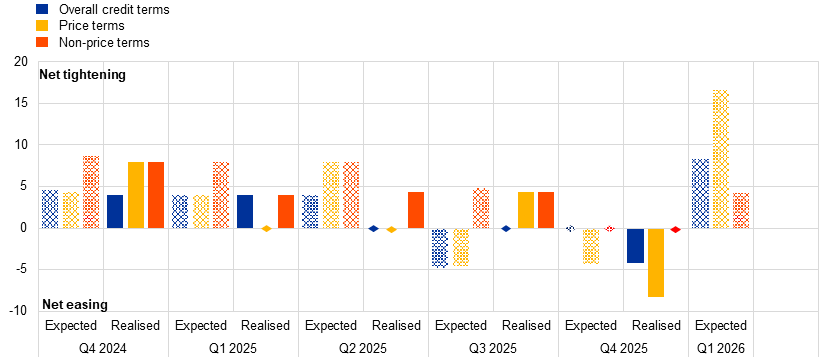
- Price and non-price credit terms and conditions remained largely unchanged between September 2025 and December 2025, with a slight easing of price terms across most counterparties. This easing appeared to be primarily driven by general market liquidity conditions, competition from other institutions, and the financial strength of counterparties. Looking ahead to the first quarter of 2026, some tightening of credit terms was expected across the board, but in particular for hedge funds. Tightening expectations were more pronounced for price terms than non-price terms (Chart 1).
Turning to financing conditions for secured funding, demand for funding increased across all collateral types, especially for domestic and high-quality government bonds. In parallel, financing rates/spreads increased for all types of collateral except asset-backed securities. In addition, the maximum amount and maturity of funding increased for all funding secured against debt instruments (not including convertible securities).
Chart 1
Expected and realised quarterly changes in overall credit terms and price/non-price terms offered to counterparties across all transaction types
(net percentages of survey respondents)
Source: ECB.
Note: Net percentages are calculated as the difference between the percentage of respondents reporting “tightened somewhat” or “tightened considerably” and the percentage reporting “eased somewhat” or “eased considerably”.
Against a background of broadly unchanged credit terms and conditions for various types of non-centrally cleared over-the-counter (OTC) derivatives, including initial margin requirements, survey respondents pointed out a few changes regarding valuation disputes. The volume and duration of such disputes appeared to have increased slightly, in particular for commodity derivatives.
Lastly, each year the final SESFOD edition of the year asks survey participants about their market-making activities and abilities. For 2025, respondents reported only minor changes in activity levels, with slight increases for derivatives and debt securities. Expected changes for 2026 were more pronounced, as respondents indicated that they foresaw increased activity across all instrument types. Furthermore, a slight majority of respondents indicated having a good or moderate ability to act as a market-maker in times of stress, registering an improvement compared to 2024 for derivatives, but a worsening for debt, asset-backed, and convertible securities.
Please note that the data from all previous rounds of the survey have been made available on the ECB Data Portal. The data can now be accessed, retrieved and visualised more easily.
The results of the December 2025 SESFOD, the underlying detailed data series and the SESFOD guidelines are available on the ECB’s website, together with all other SESFOD publications.
The SESFOD is conducted four times a year and covers changes in credit terms and conditions over three-month reference periods ending in February, May, August and November. The December 2025 survey collected qualitative information on changes between September 2025 and November 2025. The results are based on the responses received from a panel of 26 large banks, comprising 14 euro area banks and 12 banks with head offices outside the euro area.
For media queries, please contact Verena Reith, tel.: +49 172 2570849.
Europese Centrale Bank
Directoraat-generaal Communicatie
- Sonnemannstrasse 20
- 60314 Frankfurt am Main, Duitsland
- +49 69 1344 7455
- media@ecb.europa.eu
Reproductie is alleen toegestaan met bronvermelding.
Contactpersonen voor de media